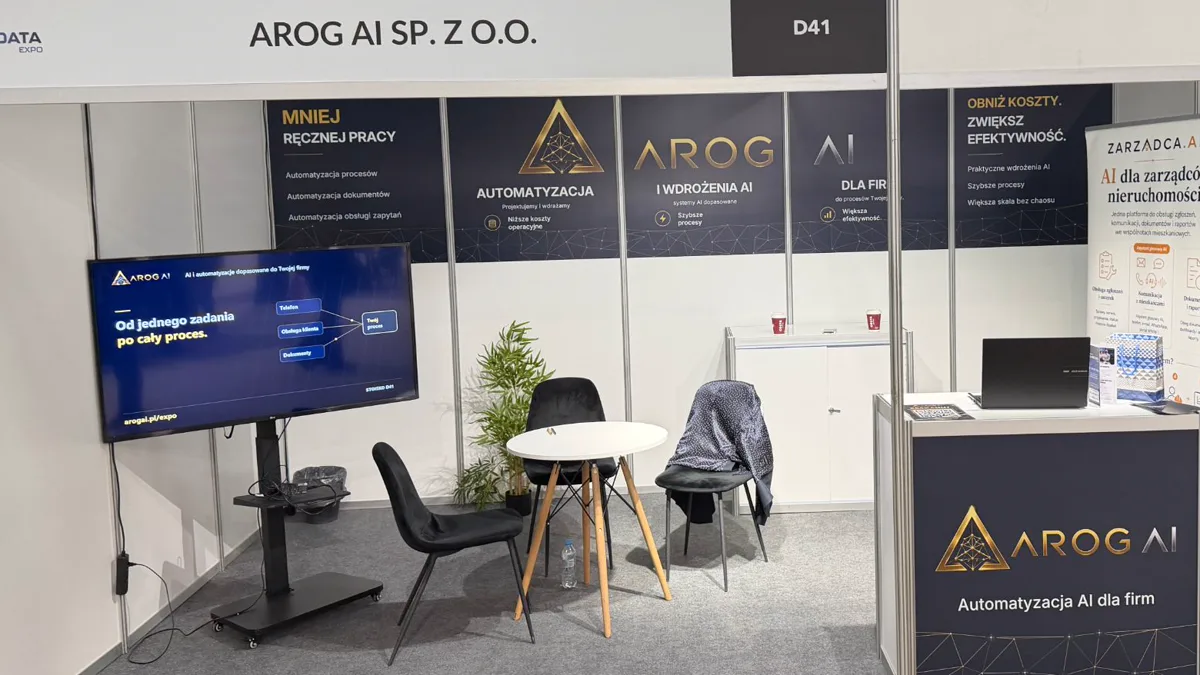
On May 20-21, 2026, AROG AI was represented at Infoshare in Gdansk, one of the most visible technology meetings in Central and Eastern Europe. We were there in person, not as a slide in a deck or a remote logo, but in the room where founders, operators, investors and innovation teams were testing the same question from different angles: what does useful AI look like when it reaches real companies?
The photo above is from the Innovation Stage. It captures the right mood of the event: practical, direct and grounded in the Polish technology ecosystem. Infoshare 2026 marked the event's 20-year edition at AmberExpo in Gdansk, and the official agenda framed the conference around technology, business, startups, investors, marketing and leadership. For us, the value was simple: compare the market conversation with what we see every week while building AI automation systems for business teams.
Why We Wanted to Be There
AROG AI builds practical automation, AI agents, document workflows and AI Act readiness systems. That means we cannot work only from tool announcements or vendor roadmaps. The useful signals come from the people who will actually approve, operate and maintain AI systems: founders, department heads, product owners, sales teams, compliance teams and technical leaders.
Infoshare is valuable because those groups meet in one place. The conversations are less abstract than the usual AI narrative. People ask about cost, delivery risk, ownership, data access, vendor lock-in, compliance and whether a prototype can survive contact with Monday morning operations.
Our takeaway: the AI market is maturing. Companies no longer need another generic "AI transformation" story. They need small, well-scoped systems that remove work, create audit trails and can be handed over to the team using them.
The Strongest Signal: Implementation Over Hype
The stage discussion visible in the photo was about supply in the Polish startup ecosystem. That topic connects directly with what we hear from business buyers. There is no shortage of AI tools. The shortage is in teams that can turn a tool into a production workflow, document the risk, connect it to existing systems and keep it observable after launch.
That is why our own work focuses on implementation details:
- Clear process selection: choosing the workflow where AI can remove measurable manual work instead of chasing novelty.
- Production architecture: connecting AI to CRM, documents, calendars, email, databases and internal approvals without creating fragile scripts.
- Governance from day one: logging, human oversight, data minimization and AI Act classification before the system becomes business-critical.
- Handover: documentation and monitoring so the client is not dependent on a black-box demo.
This is also why we keep pushing clients toward focused first deployments. A 14-day pilot that saves a team several hours every week is more useful than a six-month transformation program with no operational owner.
What This Means for Polish and EU Companies
The AI adoption window in 2026 is unusual. On one side, models and automation platforms are improving quickly. On the other side, EU companies have to prepare for stricter transparency, documentation and risk obligations under the AI Act. That combination rewards companies that move early, but move carefully.
The right question is not "should we use AI?" The right question is: which process is stable enough, valuable enough and safe enough to automate first?
For most teams we meet, the first strong candidates are document intake, customer support triage, lead enrichment, internal reporting, invoice checks, CRM cleanup and repetitive operational coordination. These are not glamorous use cases, but they are where AI starts paying for itself.
AROG AI After Infoshare 2026
Being at Infoshare confirmed the direction we are already taking: fewer vague AI promises, more measurable systems. We want AROG AI to be visible in the real ecosystem because the work is real. We build with clients, show up in the market, listen to what teams actually struggle with and translate that into practical deployments.
If your company is evaluating AI automation this year, start with an inventory of repetitive work, data sources, approval points and compliance constraints. Then pick one process and make it measurable. That is the path from conference inspiration to operational value.
Next step
Use the AROG AI audit to identify the first process worth automating, or book a short strategy call if you already know where the bottleneck sits.
Event context: Infoshare 2026 took place on May 20-21, 2026 at AmberExpo in Gdansk. See the official Infoshare website for the conference overview.
Ready to remove manual work?
Tell us which workflow slows the team down. We will map the automation path and the ROI case.
Book a Strategy CallAlso Read
- AROG AI at World of AI & Big Data Expo 2026, Ptak Warsaw Expo: Stand D41
- AI Agent Readiness Assessment: A 2026 Scoring Framework for Business Processes
- EU AI Act Article 50 for Chatbots and AI Assistants: 2026 Transparency Checklist
- n8n Consultant: How to Scope, Hire, and Get Real ROI from Workflow Automation
- AI Automation Consulting: What It Includes, What It Costs, and How to Choose a Firm
- AI Automation ROI: How to Calculate and Prove Value to Your Board
- EU AI Act August 2026: Your 90-Day Compliance Action Plan
- The Complete Guide to Business Process Automation with AI
- AI Agents vs Traditional RPA: Which Automation Approach Fits Your Business?
- 5 Free AI Tools to Assess Your Business Automation Potential
- How to Classify Your AI System Under the EU AI Act
- AI Act Compliance Checklist for SMEs
- How Much Does AI Act Compliance Cost?
- EU AI Act 2025: What Every Business Needs to Know
- 5 Business Processes You Should Automate With AI Today
- AI Audit vs AI Consultation: Which Does Your Business Need?